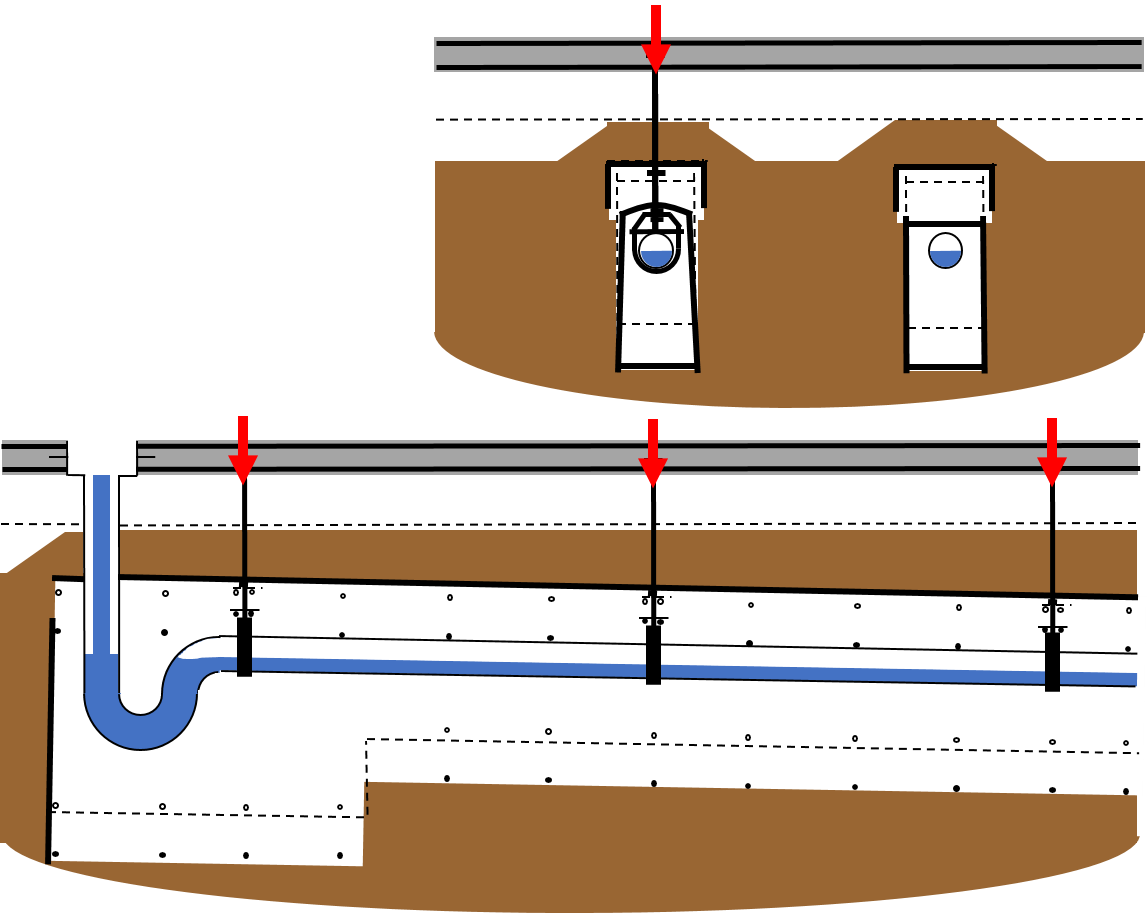
FAILURES OF NON-ISOLATED PLUMBING UNDER ISOLATED SLABS

GBA Case Study re Isolated Slabs and Non-Isolated Plumbing

“On the advice of the forensic consultant, the client chose to excavate a deep crawl space under the building floor – essentially a basement – so workers could access the sewer lines and repair them. This labor-intensive effort cost
about $8.3 million*. Not surprisingly, the client filed construction-defect claims against all the design firms
involved, the constructor-in-charge, and the mechanical constructor. The client was seeking $25 million to pay for sewer-line repairs, floor-slab repairs, interior repairs, lost revenue from residents, resident-relocation costs, attorney’s and expert’s fees, and court Costs.” *All financial factors are reported in 2020 dollars. Foundation approx. 100,000 sf

“The Member Firm agreed to a settlement two weeks before the trial; seven years after the client initiated the claim; and eleven years after the Member Firm initiated the project.”

FAILURES OF NON-ISOLATED PLUMBING UNDER ISOLATED SLABS

Examples of Litigation reported in the News re Isolated Slabs and
Non-Isolated Plumbing

FAILURES OF NON-ISOLATED PLUMBING UNDER ISOLATED SLABS

The 160 slides of the BPI Presentation go into great detail on Non-Isolated Plumbing approaches under Isolated Slabs:
– How Non-Expansive Trench In-Fill and/or Vertical Sleeving through an Isolated Slab does not solve the problem.
– How Mechanical Engineers are specifying Retaining Walls in Non-Isolated Void Systems without the Structural Engineering education and experience required.
– How Complex it would be to design a Hanger Rod (partially in expansive soil undergoing volumetric changes) for Expected Uplift.
– How Mechanical Engineers have a false sense of security because they normally specify labelled and listed products but they have been misled by Non-Isolated Void System Manufacturer’s claims about their unlabelled and unlisted products.
– How soil-retaining elements are required by the IBC to be designed for expansive soil swell pressures, which can be 100 times the structural limit states capacity of non-isolated void system components.
– How non-isolated plumbing imparts loads onto slabs that the Structural Engineer must account for in the design.

FAILURES OF NON-ISOLATED PLUMBING UNDER ISOLATED SLABS

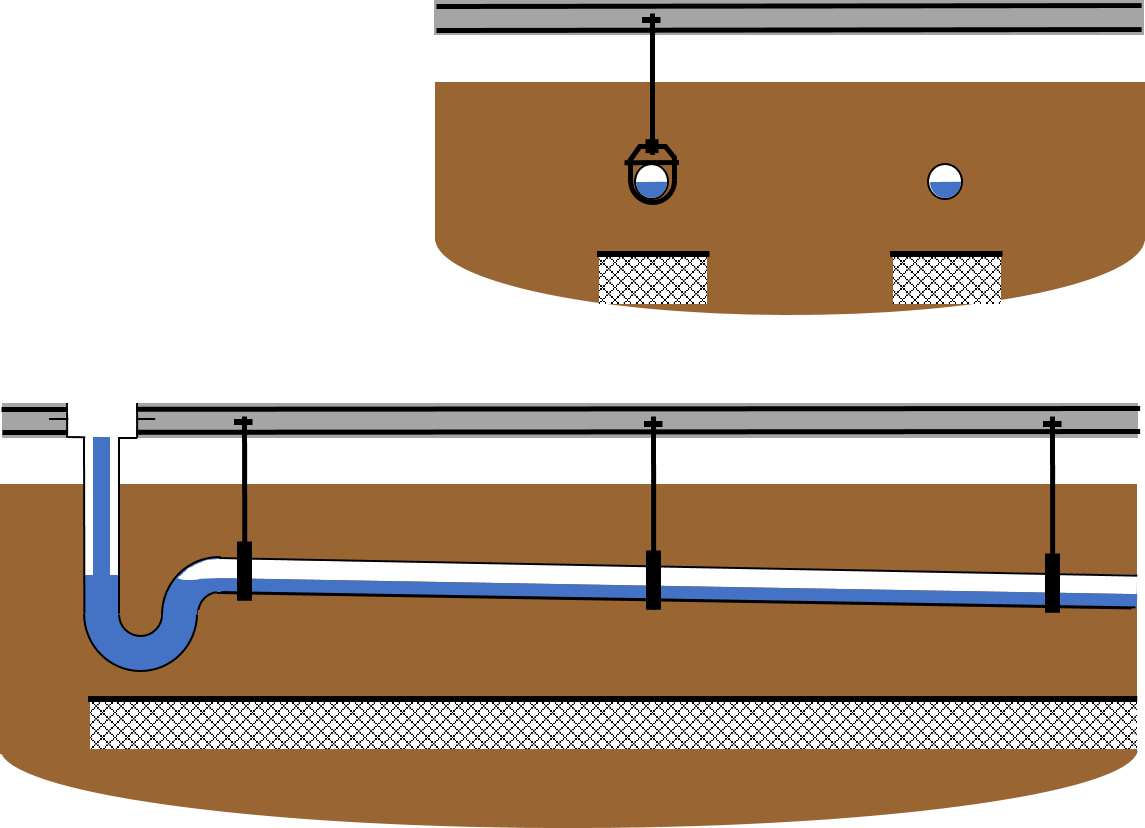
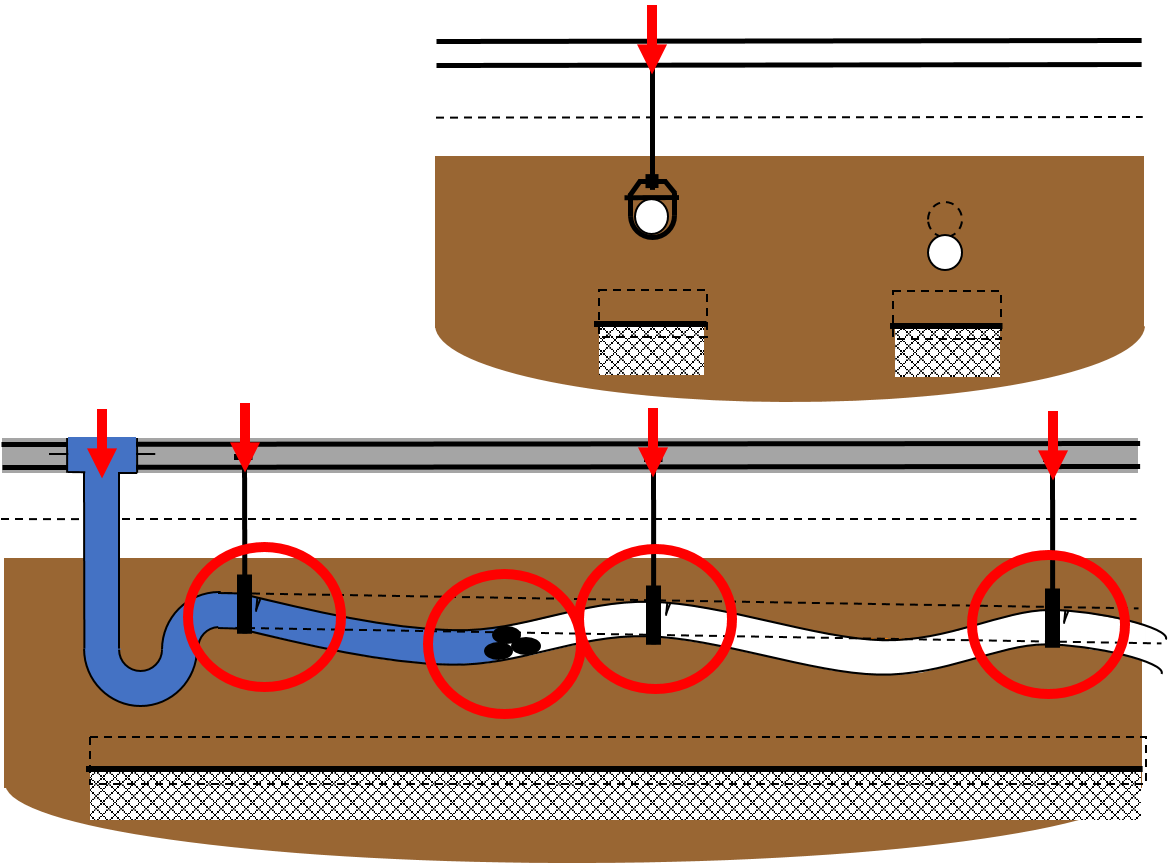
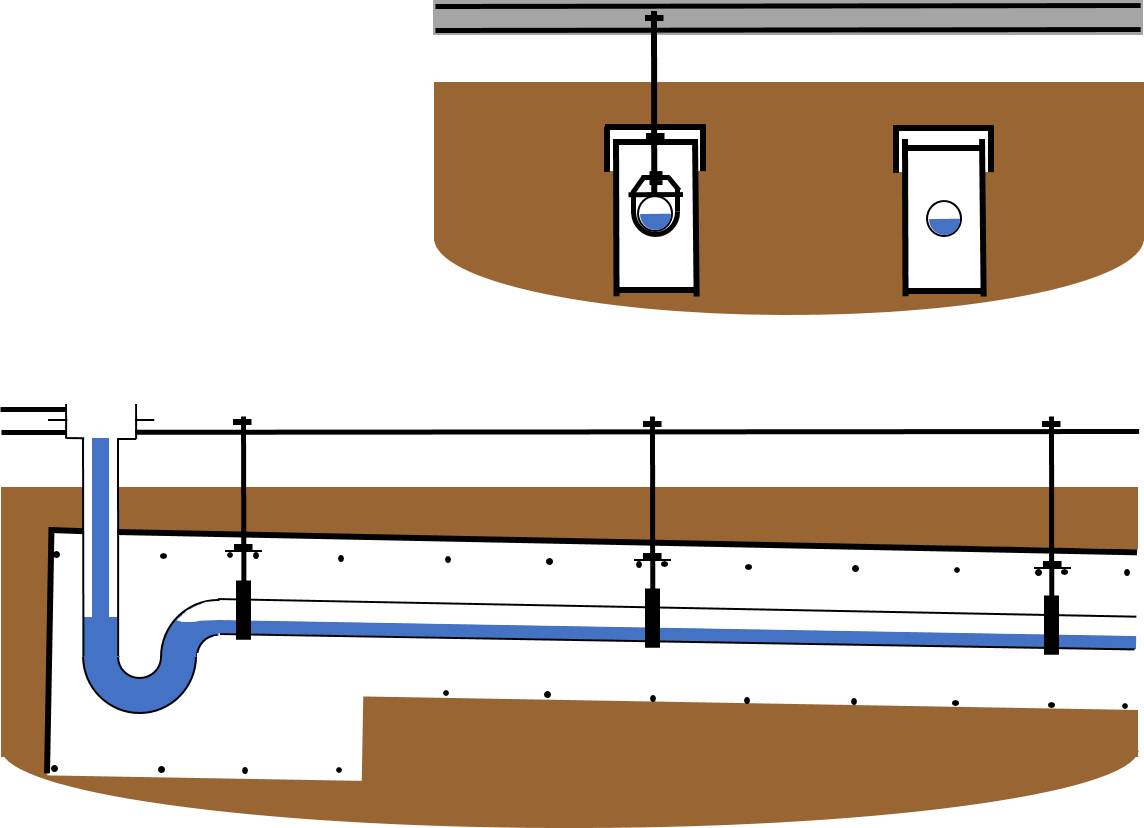
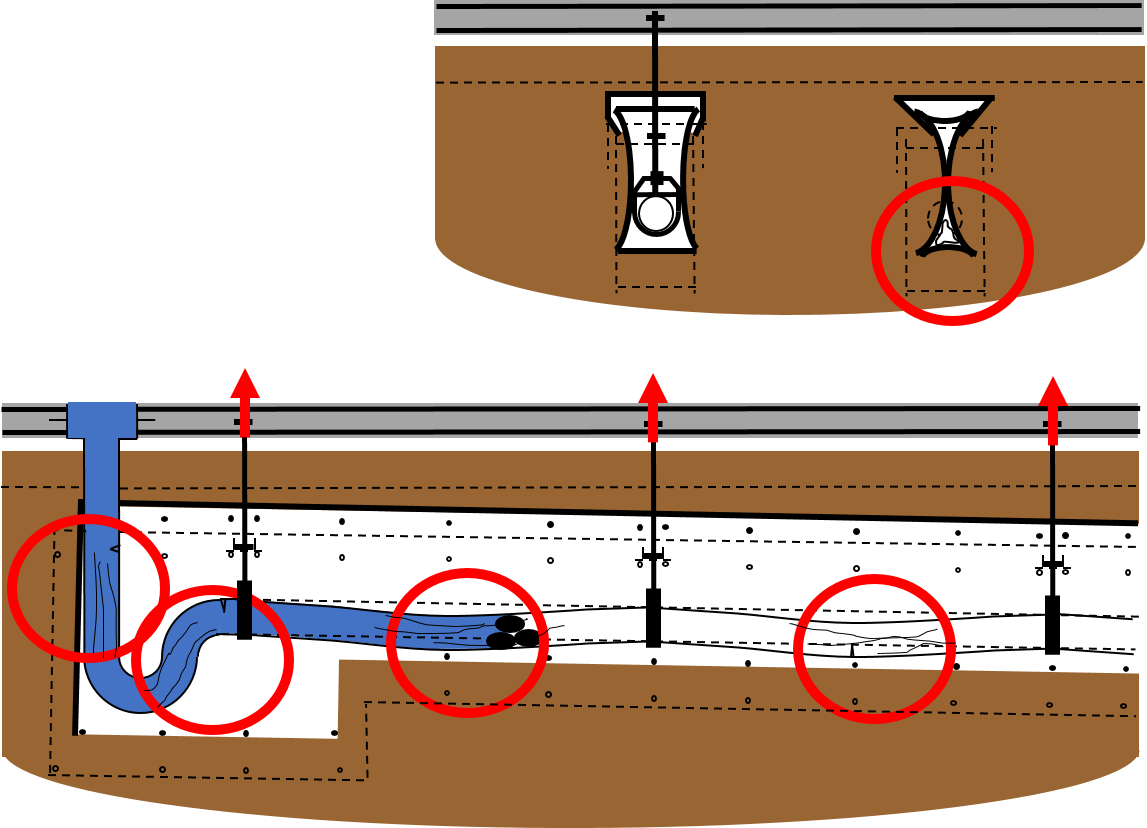
The following are some sketches from the BPI Presentation that illustrate some failure modes.

FAILURES OF NON-ISOLATED PLUMBING UNDER ISOLATED SLABS

BURIED PLUMBING

FAILURES OF NON-ISOLATED PLUMBING UNDER ISOLATED SLABS

BURIED PLUMBING
Installed Conditions

FAILURES OF NON-ISOLATED PLUMBING UNDER ISOLATED SLABS

BURIED PLUMBING
General Under-Slab Settlement

FAILURES OF NON-ISOLATED PLUMBING UNDER ISOLATED SLABS

BURIED PLUMBING
General Under-Slab Settlement

FAILURES OF NON-ISOLATED PLUMBING UNDER ISOLATED SLABS

BURIED PLUMBING
General Under-Slab Settlement

FAILURES OF NON-ISOLATED PLUMBING UNDER ISOLATED SLABS

BURIED PLUMBING
General Under-Slab Settlement

FAILURES OF NON-ISOLATED PLUMBING UNDER ISOLATED SLABS

MESH & PLYWOOD UNDER PLUMBING

FAILURES OF NON-ISOLATED PLUMBING UNDER ISOLATED SLABS

MESH & PLYWOOD UNDER PLUMBING
Installed Conditions

FAILURES OF NON-ISOLATED PLUMBING UNDER ISOLATED SLABS

MESH & PLYWOOD UNDER PLUMBING
Gen. Under-Slab Settlement

FAILURES OF NON-ISOLATED PLUMBING UNDER ISOLATED SLABS

MESH & PLYWOOD UNDER PLUMBING
Decomposed Plywood

FAILURES OF NON-ISOLATED PLUMBING UNDER ISOLATED SLABS

MESH & PLYWOOD UNDER PLUMBING
Gen. Under-Slab Swelling

FAILURES OF NON-ISOLATED PLUMBING UNDER ISOLATED SLABS

MESH & PLYWOOD UNDER PLUMBING
Perim. Under-Slab Swelling

FAILURES OF NON-ISOLATED PLUMBING UNDER ISOLATED SLABS

PLASTIC SIDE PANELS AND CROSSBARS

FAILURES OF NON-ISOLATED PLUMBING UNDER ISOLATED SLABS

PLASTIC SIDE PANELS AND CROSSBARS
Installed Conditions

FAILURES OF NON-ISOLATED PLUMBING UNDER ISOLATED SLABS

PLASTIC SIDE PANELS AND CROSSBARS
Gen. Swelling, No Rod Buckling

FAILURES OF NON-ISOLATED PLUMBING UNDER ISOLATED SLABS

PLASTIC SIDE PANELS AND CROSSBARS
Settlement/Shrinkage

FAILURES OF NON-ISOLATED PLUMBING UNDER ISOLATED SLABS

NET HORIZONTAL FORCES

Soil swelling on one side of a Non-Isolated Void System can create net horizontal forces that push Non-Isolated Void Systems and damage plumbing.

FAILURES OF NON-ISOLATED PLUMBING UNDER ISOLATED SLABS

SWELL/SHRINK CYCLE DEFORMATIONS

Designers need to also carefully consider the effects of swell/shrink cycles on the deformed shape of non-isolated void systems.

FAILURES OF NON-ISOLATED PLUMBING UNDER ISOLATED SLABS

In summary, the problem is that an unprecedented and possibly unobtainable level of inter-disciplinary testing and design coordination, plan review and plumbing inspection would be required on each project between the Geotechnical, Mechanical and Structural Engineer to properly protect plumbing using non-isolated plumbing approaches that have been used. A Plumbing Inspector does not have the ability to verify this occurred.

CODE HISTORY

CODE HISTORY

ASA A40.8 National Plumbing Code
1955 Edition

Some of the relevant “Basic Principles” in this document indicate that protection of plumbing from expansive soil is a health, safety and welfare issue.

CODE HISTORY

ASA A40.8 National Plumbing Code
1955 Edition

Principle No. 9: The piping of the plumbing system shall be of durable material, free from defective workmanship, and so designed and constructed as to give satisfactory service for its reasonable expected life.

CODE HISTORY

ASA A40.8 National Plumbing Code
1955 Edition

Principle No. 18: Where a plumbing drainage system may be subjected to backflow of sewage, suitable provision shall be made to prevent its overflow in the building.

CODE HISTORY

ASA A40.8 National Plumbing Code
1955 Edition

Principle No. 19: Plumbing systems shall be maintained in a sanitary and serviceable condition.

CODE HISTORY

ASA A40.8 National Plumbing Code
1955 Edition

Principle No. 22: Sewage or other waste from a plumbing system which may be deleterious to surface or subsurface waters shall not be discharged into the ground or into any waterway unless it has first been rendered innocuous through subjection to some acceptable form of treatment.

NEW LANGUAGE IN THE 2024 IPC

NEW LANGUAGE IN THE 2024 IPC

International Plumbing Code
New Language in the 2024 Edition

Explicitly requires protection of plumbing from expansive soil and defines when expansive soil is present.

Allows buried plumbing under Slabs-on-Ground.

Requires complete isolation of plumbing under Slab-on-Crawlspace and Slab-on-Voidwork: “It shall not be permitted for the plumbing, hangers and supports below the slab or below the framing to be in contact with soil or any assemblage of materials that is in contact with soil within the active zone.

Exception 1 allows buried pipe for drainage of crawl spaces

Exception 2 allows attachment to piers if the plumbing, hangers and supports are otherwise isolated.

RECOMMENDATIONS

RECOMMENDATIONS

FOR PLUMBING ENGINEERS

We recommend Mechanical/Plumbing Engineers immediately cease and desist the practice of allowing Non-Isolated Plumbing (Buried Plumbing or Non-Isolated Void Systems) under Slab-on-Voidwork or Slab-on-Crawlspace foundations, regardless of whether the IPC or UPC applies or whatever edition applies, whatever the geotechnical engineer estimates to be the probability of movement occurring, whatever the building official will allow, and however hard the owner demands to reduce the initial cost of construction and claims they will accept the risks of damage that would requiring extensive and repeated maintenance.

We recommend Mechanical/Plumbing Engineers immediately begin complying with the new provisions in the 2024 IPC (provided in this presentation) for protection of plumbing from expansive soil, which is also recommended by the Geoprofessional Business Association:

Non-Isolated Plumbing is allowed under Non-Isolated Slabs

Isolated Plumbing is required under Isolated Slabs

RECOMMENDATIONS

FOR BUILDING OFFICIALS

In regions where expansive soil is common, we recommend Authorities Having Jurisdiction adopt the new language in the 2024 IPC for the protection of plumbing from expansive soil.

Alternatively, where expansive soil is present and slabs will be isolated from the expansive soil, we recommend Building Officials require a single, comprehensive report be submitted by a combination of a qualified Geotechnical Engineer, Structural Engineer and Mechanical/Plumbing Engineer, providing analytical justification showing how the plumbing will not be over-stressed or over-strained if the possible expansive soil movement and expansive soil swell pressures predicted by the Geotechnical Engineer actually do occur.

Thank you

In order to receive your CEUs for this session please visit education.aspe.org to complete the session survey and brief learning assessment. Once you’re logged in, visit My Education and you’ll navigate to this session to take the applicable survey and learning assessment.
Please contact ASPE Education with questions.

Copyright 2023 American Society of Plumbing Engineers